Thursday, May 26, 2011

Cosco: reversal ?

Cosco 52 wk high : 2.44 ( 19 Jan 2011)

Cosco 52 wk low: 1.32 (27 May 2010)

Candlestick: White candlestick with little shadow is a testament to the bullish sentiment and a possible reversal.

MACD, Stochastics: Turning up, no negative divergence. Slight positive MacdH divergence.

Resistance: 2.01 (200MA) , 2.08, 2.17

Support: 1.90, 1.79-1.8

Today Cosco closed at 2..00 (+2.4%) with high volume of 34.9M shares traded, double the previous day’s volume of 17.3M shares. This is a positive sign as it shows accumulation as the up volume today was significantly higher than the previous day’s down volume. Also the low of 1.89-1.9 was successfully tested for 3 days in a row (20-22 May), affirming the strength of that support region.

Another positive sign is that out of the 34.9 M shares traded, 27M, or 77% of the total amount, were transacted at 1.97 or higher, which is above the previous close of 1.96. 8.4M and 17M shares were transacted at 1.99 and 2.00 respectively, so there should be decent support in that area. If cosco keeps on making higher and higher lows, it could well be the beginning of a new uptrend.

The chart shows a potential double top at 2.40-2.44 but this will not be confirmed unless the neckline at 1.80 is broken convincingly. Cosco still remains in its uptrend which has been maintained since the lows of 2008. As you can see the lower trendline has been tested (or come close to being tested) convincingly several times , showing the strength of the trend.

Cosco seems to be resisted by the 200MA at 2.01 now. It is therefore at a critical point now, if it clears the horizontal resistance and 200MA at 2.01, it has a good chance of retesting 2.08.

I took a small position today at 1.99, after observing the surge in volume which accompanied the buying.

2 possible strategies:

1) Go long when 2.01 is broken to the upside on high volume

2) Go short when 1,79( Mar low) is broken to the downside on high volume.

Thursday, April 14, 2011

Straits asia: facing selling pressure


Today straits asia closed at 2.54 with above average volume of 7.8 million shares.

The full black candlestick with no shadow indicates that selling pressure is still strong. The closing at 2.54 is just below the confluence of the 20MA and 100MA. Straits Asia had been trending up on the upper Bollinger band until recently. The 100MA at 2.50 may also provide some support.

RSI is trending down and MACD is on the verge of a bearish crossover which will probably happen if another down day occurs tomorrow.

Straits asia also appears to have broken its uptrend channel which is a bearish sign. Expect more downside if the uptrend channel cannot be recaptured.


Strategy : Watch whether the 20MA at 2.55 can be regained, if not it is quite likely that the support of 2.50 will be tested, followed by 2.40. Be cautious as MACD is about to form a bearish crossover.

Friday, April 8, 2011

STI: Still going strong


On Friday STI closed at 3187.31 , the 8th consecutive day of gains, and 13th positive day of the last 15. The gain from the yearly low on March 15 of 2919.98 is 267.33 points or 9.15%. The index is still some 3.8% below the 9 Nov 2010 high of 3313.61. It is also worth noting that April is quite a bullish month for STI with 7 of the last 10 Aprils resulting in gains.


The top blue line on the chart shows where STI is at now.

Indicators are nearing overbought territory with the RSI near 70 and closing near the upper bollinger band. However today's close at the high of day shows the bullish strength of the rally and indicates that the index could even move past the 3200 level after a correction.

I am expecting a brief correction for STI to the 3120-3150 region. Support at 3110-3120 should be especially strong as 3110 is the neckline of the double-bottom pattern and 3120 has been tested successfully before. In a more bullish scenario STI might only correct to 3150, consolidate and resume trading in the next band at 3180-3220. Stronger resistance is at 3220. A good thing is that there are no negative divergences..

Strategy: Reduce holdings as STI is currently overbought and refrain from taking more long positions until there is a correction.

NOL : Out of downtrend ?


Today NOL closed at 1.99 with good volume of 27 m shares traded. Prices touched a high of 2.01 which was again not sustained into the close..

Things seem to be brightening up for NOL as it seems to have moved out of the downtrend channel and into a slight uptrend(see chart). Also it managed to close above the 20MA. Sustained closes above 20MA would indicate that the trend is indeed changing. Important resistance is at 2.02 as this level was tested unsucessfully several times in the past. If 2.02 is taken out, 2.10 will be a possible target. Immediate support is at 1.94, However STI is currently overbought and I think the price is likely to see consolidation for a few sessions before moving higher.

I also noted that the Bollinger bands are tightening, indicating that a large move is near.

Why I bought NOL at 1.93 last Friday?

1) Gentler slope of downtrend indicating that selling pressure is easing

2) Slight positive Macd /RSI/Stochastic divergence as seen in the chart. Prices made a new low but Macd/RSI/Stochastics edged up.

3) Strong support at 1.87-1.92 region (Aug 2010 low, Fibonacci support)

All these factors indicated that the downside is minimal and so I took a small position.

Watch the next few sessions. It will be a good sign if the price can maintain above 20MA and 1.92 is not broken.

Monday, March 28, 2011

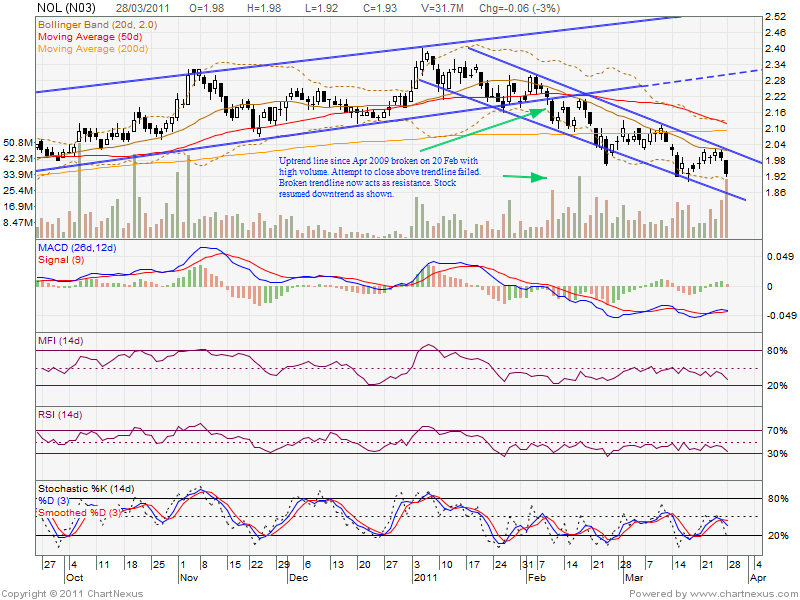
NOL: Still in downtrend


NOL's price has been constantly weighed down by high oil prices and closed at 1.93 on high volume of 31.7 m shares today.


First take a look at NOL's long-term chart. The stock was in a steady uptrend since Apr 2009, after which it broke its uptrend on 20 Feb ( see next chart) and failed to close above it. After this trendline was broken, NOL started falling more rapidly. In fact it had already been in a downtrend since 5 Jan when it peaked at 2.40, forming a series of lower highs and lower lows but the broken uptrend further confirms this and makes it more bearish. NOL has also been continuously under its 20 day MA, which is falling with the 50 day MA, confirming the downtrend. This counter looks more like a candidate for going short although even for bearish stocks there are still opportunities for going long. The green line shows the 1.90 level which is quite an important support level.


Important support: 1.89-1.90 (24 Aug 2010 low, 38.2% retracement from 2.40-1.04) , 1.75 (May 25 2010 low)
Important resistance : 1.98, 2.02

MACD and RSI are still trending down which is bearish. The price has also failed to close above the 20 day MA indicating that the trend is still down

NOL is trending downward and the upper downtrend line at 2.01 is also acting as resistance as NOL always experiences profit taking around that level and it also made a large move lower today on high volume. Price is also below the 50 day MA and 200 day MA at 2.12 and 2.08 respectively.

Strategy: Possibly buy around 1.90 which is near several important support levels and near channel bottom. For a downtrending stock, buying at top of channel is a strict no-no. Take partial/full profits at top of channel. Buy on breakout of downtrend channel if accompanied with high volume, preferrably after sustained closes above 20 day MA showing that trend has reversed.

I usually prefer to buy strong uptrending counters on temporary weakness than buy weak counters on breakout as it could be a fake breakout.

STI is finally taking a pause today after 5 straight up days last week. I am pleased to have taken profits on CityDev at 11.72 on Friday.

Thursday, March 24, 2011

Noble Grp : Testing upper downtrend channel


On 24 March, Noble Grp closed at 2.15 with average volume of 31.6 m shares traded.

Resistance levels : 2.16( downtrend resistance, green line) , horizontal resistance (orange line, tested on 18 Feb, 7-9 Mar),
2.25 ( 3 Mar high) , 2.32 (7 Feb high), 2.40 ( 13 Jan high)

Support levels: 2.07, 2.00, 1.94 (15 Mar low)

Indicators: MACD, RSI and Stochastics turning up

The defining features of the chart are the downtrend since 13 Jan that Noble Grp is still in, as well as a potential double bottom that may have formed at 1.94-1.96, on 24 Feb and 15 Mar. The steady rebound from the low of 1.94 further proves that 1.94-1.96 is a strong support region.

Noble also bounced off the 200 day MA of 1.94 on 15 Mar which is a good sign, indicating that sentiments are still bullish,

Noble closed just shy of the resistance at 2.16 which is fairly strong but if it can be broken with healthy volume 2.25 could be seen in due course. If the downtrend channel (green line) is decisively broken, Noble Grp could resume its uptrend movement and possibly test 2.40 in the future.

On another positive note, STI managed to recapture 3040. Hopefully this resistance will become support.

Tuesday, August 31, 2010

Singtel : bullish reversal or technical rebound ?


Singtel's price hit a low of 2.92 on 16-17 Aug and has since rebounded somewhat to 3.05. Is it a bullish reversal or merely a technical rebound?

I bought Singtel at 2.93 on 23 Aug. Some reasons for buying-

-Prices have been tagging the lower bollinger band for several days. Better than average odds of reversal.
- Prices were nearing long-term support of 2.86-2.90
-RSI is bordering on oversold, around 30
-Presence of candlesticks with long lower wicks from 17 Aug to 23 Aug. Although the price traded as low as 2.92, prices never closed lower than 2.94. This suggests strong support in the 2.92-2.93 region and that the selling pressure was easing.
-Spinning top candle on 19 Aug, suggests indecision and possible change of trend.

As of now, prices have rebounded to the 3.05 region, right in the middle of the bollinger bands. Prices are in a slight uptrend, as you can see from the chart, but are probably in consolidation mode. A bullish MACD crossover was also observed on 30 Aug. Prices are also just above the 200DMA(3.04) but slightly below the 50DMA(3.06). There is some pretty strong resistance at 3.10, which is the high of 10Aug before prices dropped to 2.92, while 3.00 should prove to be strong psychological support.

I would be bullish if 3.10 can be broken with high volume, however I feel that any upside will be limited to 3.10-3.12. For now, I am still holding.

Please do comment if you like this post.

Sunday, April 25, 2010

Which would you choose?

If you had a 20% chance to win $5000, winning nothing on the 80%, Or an 80% chance to win $1000, winning nothing on the 20%, which would you choose?

Think about it.

Wednesday, April 7, 2010

What would you do ?

Lets say that you are given a choice of 2 things- $5000 cash, or a holiday package to your favourite destination worth $7000.

Which would you choose and why ?

Monday, April 5, 2010

5 simple technical indicators that I often use

Technical analysis can be quite useful in determining good entry and exit points, whether for short-term or long-term positions. Of course using Fundamental Analysis will be more important for long-term positions.

Candlesticks aside, here are 5 simple technical indicators that I frequently use. These indicators are best used in conjunction with one another to provide a more accurate picture.

I have attached the latest chart of Starhub to use as an example.


The first thing to do when looking at a chart is to determine the direction of the stock- whether it is in a downtrend, uptrend or in a sideways trading movement. Then I would take a look at some of these technical indicators.

1. Support and resistance lines

Support and resistance represent key junctures where the forces of supply and demand meet. Prior to the breakout, resistance was established at 2.30 and short-term support was at 2.15. Longer-term support, established last October is at 1.87. Since then there was a large move upwards which sent prices as high as 2.38, reaching a 15-month high. The breakout could have turned the 2.30 resistance level into support.

Strategy: Buy when price reaches support levels and sell/reduce positions when price approaches resistance levels.

2. Trendlines

Trend Lines are an important tool in technical analysis for trend identification. They can be drawn by connecting 2 or more price points together. We can see that Starhub is in an obvious uptrend. Prices are currently at the top of the trend channel. Decisive trendline breaks can signal that the a trend change is imminent.

3. RSI ( Relative Strength Index)

The RSI reading shows whether a stock is oversold or overbought. Readings can range from 0 to 100 and a reading of 30 or less shows oversold conditions while readings of 70 or more show overbought conditions. However stocks can remain overbought or oversold for long periods so it is best to use this indicator together with other indicators. Keep a look out for positive divergences, where the indicator makes a higher high even though the price does not, and negative divergences, where the indicator fails to make a higher high even when the price makes a new high. Starhub is mildly overbought at the moment with an RSI reading of 72.

Strategy: Be wary when stock is in overbought region. Accumulate when positive divergence seen and sell/reduce positions when negative divergence seen.

4. MACD

MACD- A simple indicator which uses moving averages, typically calculated from the 12 and 26 day EMA (Exponential moving averages).It is best to use it together with other indicators as there can be fake moves. For Starhub, there are no sell signals for the MACD yet. The blue line is still above the signal line.

Strategy: Sell when the MACD line moves below the signal line, center line or when negative divergence is observed. Buy when the MACD line moves above the signal line, center line or when positive divergence is observed.

5. Bollinger bands

Bollinger bands- another useful indicator which measures volatility and relative price levels over a period of time. They are useful in identifying periods when prices are at extreme, and possibly unsustainable, levels. Prices tend to reverse when they exceed the upper or lower band. Also, when the bollinger bands tighten up, it usually shows that a large move is imminent. For Starhub, the last closing price of 2.36 is just out of the upper bollinger band at 2.35, so a short pullback may be likely.

There are other useful technical indicators such as moving averages, ADX etc but I will stop here for now.

Thursday, April 1, 2010

STI - 1 more hurdle to clear...

If it is going to show a true breakout to the upside.

The market showed considerable strength today, reversing all of yesterday's losses and more with a 1.9% gain to close at 2943.02. Gainers outnumbered loses by 360 to 129. Although the figures seem impressive, the volume of 1415M shares traded (compared to 1646 M the day before) was less so, and in fact quite mediocre.

STI made a high of 2946.28 today, a high close for the year but this is still slightly short of the high of 2947.08 attained on 11 Jan 2010. In order for a breakout to the upside to be possible, STI has to clear the hurdle of 2947 convincingly over the next several sessions. This could possibly stir more buying interest.

More and more index stocks are making new 52-week highs, such as Jardine C&C($31.28), KeppelCorp( $9.44) , Starhub ($2.36) and NOL ($2.15). However there are several laggards whose prices have yet to make new 52-week highs, such as Singtel($3.19) , Capitaland($4.04) and SGX($7.73) ( which is one of the most bearish stocks in the index now, currently below its 20, 50 and 200 day MA)

However, STI will also face considerable resistance at this level.

Take a look at the long-term chart. STI faces 3 resistance points at the 2950 level. If the breakout fails, it could result in a bearish double-top formation..

Saturday, March 27, 2010

STI- Where is it headed ?

The STI has been consolidating around the 2880-2920 level of late. It is still showing relative strength and is well off the low of 2665 attained on 8 Feb. Volumes have been rather low of late, signalling that many investors are still on the sidelines, waiting for clearer signals before they move in. Will the corporate results in Apr-May provide sufficient strength for the STI to cross the 3000 barrier?

However it is close to overbought territory with an RSI in the 60s. The MACD line isalso almost converging with the signal line. A minor correction could produce a bearish MACD crossover. if the STI fails to cross the previous high of 2950, it could develop a double top pattern, which is rather bearish.


For the STI, I see 3 possible scenarios.

1) Consolidation around the 2850- 2930 level for the next 2-3 weeks, before breaking through the 3000 barrier

2) Consolidation for 2-3 weeks, before experiencing a 3-5% correction to 2750-2800. The uptrend then resumes.

3) The STI experiences a correction of 7-15%, possibly falling to 2500-2600.


I am leaning towards the 2nd scenario. Which scenario do you think is most likely ?


Bearish MACD divergence was also seen on the Nikkei. There is negative divergence on both the MACD and the MACD histogram, both on different time frames. The index made a higher high at 10996.37 on 26 Mar while the indicator failed to make a higher high.

Sunday, March 7, 2010

Capitaland Technical analysis

Decided to do a TA on Capitaland. Any comments would be appreciated.


Do click on the chart to take a better look.

As you can see, prices have broken down from a plateau and double top and are now trading in the 3.62-4.00 region. There is an unfilled gap created on 22 Jan by a large move downwards. It remains to be seen whether prices will recapture that region. I do not think it will be easy as there is some short-term resistance around 4.02 to clear first. 4.02 was tested unsuccessfully after which prices retreated to the 3.70-3.80 level. The more times a resistance is tested, the more formidable it becomes. There is some fairly strong support at 3.60-3.70

Prices are just above the 200-day moving average at 3.89, which should provide short-term support.

As for the indicators, MACD is still trending up above the signal line, which is slightly bullish. RSI is neither overbought or oversold at 53%.

For the next week, I expect Capitaland to retest the 4.00-4.02 region. How it performs after that will depend on whether prices can clear the resistance at 4.02. I expect the possibility of short-term upside to be greater than the possibility of downside.

Sunday, February 28, 2010

February in review

February was a quiet month of consolidation for most financial markets, which took a breather from the more significant correction in January. After hitting a low during 5-6 Feb, most markets bounced back and have been inching up steadily for the remainder of the month. Despite mixed economic news from the US such as jobless claims rising 12% in a few weeks to 496k and existing home sales declining by some 23% in 2 months, the markets shrugged it off and continued trading in a narrow range. Trading volumes in February were also noticeably lower than January. The STI ended flat, up only 5.5 points to 2750.8

Many experts are divided in their outlook over the next few months, however it seems to me that more people are bullish than bearish. For me, I am of the opinion that the markets will go lower first before heading higher. I do not reckon that the STI high of 2947 will be surpassed anytime soon. However a correction of 5-10% would present a good opportunity to increase one's positions in blue chip and other strong dividend-yielding stocks, such as SPH, Suntec Reit, SATS, Starhub, Noble, Olam, CDL Hospitality etc.
Over the longer term (1-3 years), I am more bearish, as there are several problems that have not been sorted out.

Take a look at the table below to see how some of the global markets performed this year.


NameJan changeFeb changeYTD change
STI-5.3%+0.2%-5.1%
Hang Seng-8.0%+2.4%-5.8%
SSE-8.8%+2.1%-6.9%
Nikkei-3.3%-0.7%-4.0%
DJIA-3.5%+2.6%-1.0%
Nasdaq-5.4%+4.2%-1.3%
S&P-3.7%+2.9%-1.0%


Saturday, February 20, 2010

Portfolio strategy- how to adapt to changing market conditions

Different people have different risk appetites. One should have a portfolio of equities that is best suited to his or her needs and the market conditions, and if possible, other investment instruments such as bonds, commodities or money market funds to hedge against risk.

Efficient asset allocation can make the difference between a good investor and an outstanding investor. He must be able to feel the prevailing trends in the market, have foresight and not be too greedy where profits are concerned. If equities are overvalued, it is perhaps time to take some money out of equities and into lower-risk assets such as market funds, defensive stocks or cash. If equities are generally undervalued or the economy is just coming out of a recession, it is probably wise to increase exposure to equities, particularly growth stocks which are better beneficiaries of the recovery, compared to defensive stocks.

Where equities are concerned, my strategy is to have 3 portfolios with 3 different time frames. The 3 portfolios are for different purposes, have different levels of risk and will usually contain different stocks. Some stocks can fall into more than 1 category. Depending on the individual's preference, one may want to allocate a varying percentage of capital to each portfolio.

The ultimate purpose of each of the 3 portfolios is capital appreciation and growth.

Portfolio 1- Yield/Dividend portfolio

Objective: To generate long-term and stable passive income from dividends ( at least 4-5% annualized return).
Time-frame: 1 year to 5 years or more
Risk: Low to medium
Examples of companies: SPH, Starhub, M1, Singtel, SingPost, Suntec Reit, CapMall Trust, CapitaCom Trust, MIIF

It would be good to buy more on dips when the stock is undervalued and the long-term prospects still look good.

Portfolio 2- Growth portfolio

Objective: For long-term capital appreciation of the stocks
Time frame: 3 years or more
Risk: Medium to High
Examples of companies: Olam, Noble, Oceanus, Ezra, Ausgroup

Companies which fit this portfolio includes those which have plenty of room and potential to grow over the next few years. The quality of the management should be an important factor in this.

Portfolio 3- Short-term trading portfolio

Objective: Short-term trading for capital gains
Time frame: a few days to 1 month
Risk: medium to high

This portfolio is for trading for short-term gains during market swings. Defensive stocks should not be used for short-term trading so much as they usually move less compared to other stocks.
It is better to allocate a smaller amount of capital to this portfolio compared to the other portfolios, say 10% to 20%. Good technical analysis is required.

Thursday, February 4, 2010

STI Mid-week update


Another week of consolidation for Asian markets. The STI, which still seems to be rather weak, rebounded off the low of 2706 before declining to 2750 on Thursday. With yesterday's bounce up, STI is much less oversold with a RSI reading of 30.

STI is still hovering around the 100 day SMA of 2753. Another possibility is for STI to retrace 50% to 61.8% of the recent move down over the next few weeks. 50% retracement is at 2825 while 61.8% retracement is at 2855. However I expect the STI to be consolidating in the 2720-2770 region for a few days. if 2780 is broken convincingly, we could see more upside. I do not expect the 2680-2700 level to be broken any time soon as there is some strong support in the area.

Meanwhile, the Hang Seng broke briefly below the 20000 level before rebounding strongly to a high of 20780. The SSE also hit a low of 2890 before rebounding strongly to its close of 2995 on Thursday.

In the US, the Dow recorded its best 2-day gain in 3 months- just a technical rebound or resumption of a bullish trend?

Monday, February 1, 2010

Dow statistics

It has been widely quoted that from past records, the Dow ends up positive 70% of the time when January was an up month and 90% of the time when its first 5 trading days are positive, which is what happened this year. However the Dow lost its gains and finished -3.7% for the month, signaling that a major trend change could have occurred in the middle of the month.

Not so sure about the reliability of the second statistic as the sample size is probably much smaller- the number of years beginning with 5 consecutive up days is certainly much smaller than the number of positive January months.

Perhaps a better way to refine the statistics would be to check on the years where the Dow fulfills these criteria (which is what happened this year) and check the % of years where it was :

-Up for first 5 trading days of the year
-Down for January

On a separate note, February is quite a neutral month for the STI.

Sunday, January 31, 2010

STI- looking bearish


STI is currently at 2745, just under 100 day Moving-Average of 2751. Next 2 weeks will be very important for STI. Failure to recapture the 100 day MA soon could lead to even more downside. Look for support at 2710 and 2660. A weak rebound might happen next week.

Also a bearish crossover of the 34 day EMA over the 13 day EMA (both fibonacci numbers) was recently seen on the STI on 27 Jan 2010. The last time this happened was on 15 Jan 2009 and the STI subsequently declined by 15%. This does not look good in the short-term for the STI.

My general investing/ trading tips

Here are some of my general tips:

1. Don't chase a stock simply for the sake of chasing it, unless there are supporting technical indicators( eg. breakout in price and volume)

2. Look to volume as a supporting indicator. Increasing volume confirms the trend. Decreasing volume on increasing price shows that the trend is suspect.

3. Go for value. (to be determined by FA) "Price is what you pay, value is what you get."- Warren Buffet

4. Try to see the bigger picture- the long term view over the next 6-12 months. Don't be overly focused on the short-term.

5. Employ good TA( technical analysis), FA, money management, risk management and emotional control (taken from createwealth8888)

6. Look at investor sentiment as a contrarian indicator. Quite reliable at predicting market tops/bottoms. In Mar 2010 the % of bulls was only 2%, whereby the market soon bottomed.

7. The stock market is a leading indicator, forward-looking by 6 to 9 months. The market usually bottoms out or peaks before the economy. So buying stocks when the news is all good may not be a very good idea.

8. Always do your own research and analysis before making decisions on whether to buy or sell. Don't always take analyst's recommendations for what they are. People might have their own motives or intentions for their stock calls.

Purpose of this blog

The purpose of this blog is to :

1. Consolidate and express my views about the local and global markets, as well as investing in general.

2. Provide a collection of useful links to informative stock blogs (both local and US)